The Tale of Tails: Defining the Towers Stereo Reverberant Filter
Corey Jenkins
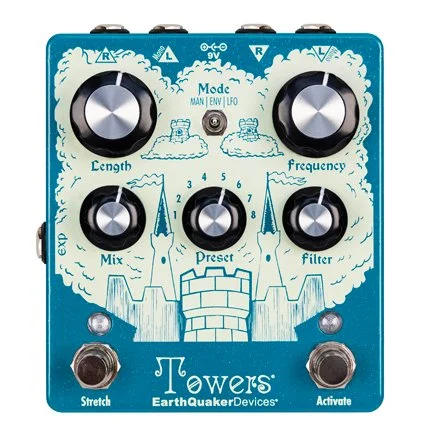
Recently we released arguably the most EarthQuakery pedal we’ve put out in years—the Towers Stereo Reverberant Filter.
And in some ways, it might also be the most misunderstood pedal we’ve released in a long time.
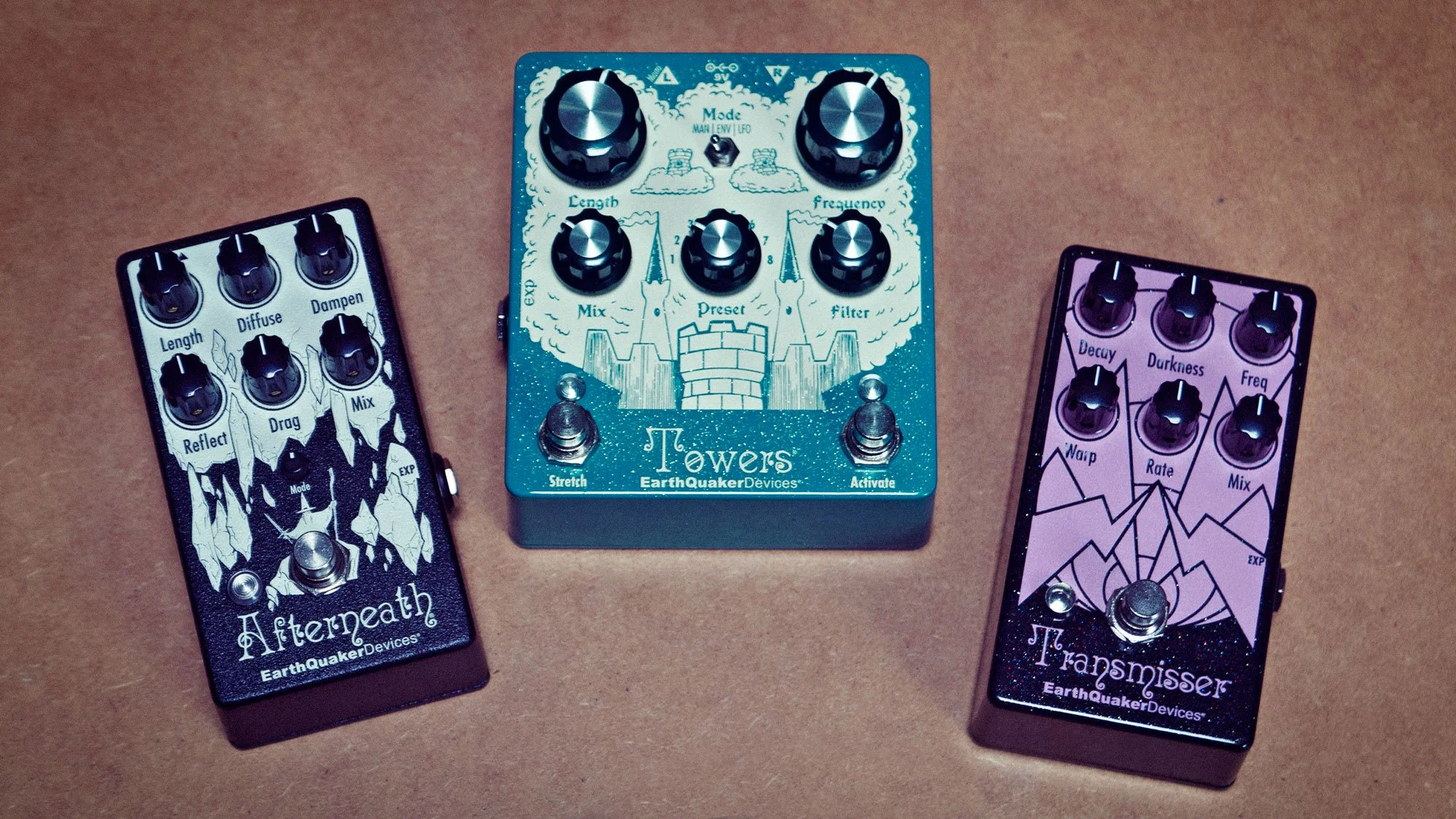
On the surface, Towers may seem like it has a lot in common with our other reverb devices, but it is truly a creature unto itself. It’s not an evolution or a redux; it’s the next phase in a linear progression of reverbs for EarthQuaker Devices. To help define Towers and distinguish it from its cousins, let’s look at it next to the two it gets compared to the most: Afterneath and Transmisser.
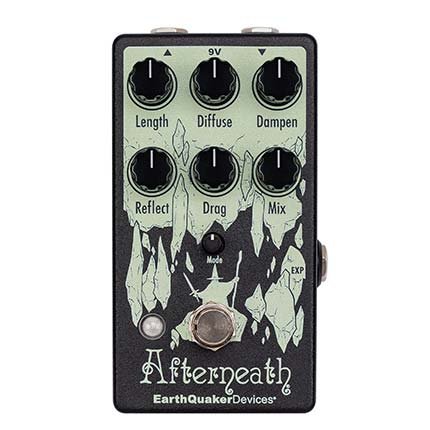
Towers Stereo Reverberant Filter vs. Afterneath Enhanced Otherworldly Reverberator
First things first: Towers is not a stereo version of Afterneath. If it were, it wouldn’t be called Towers—it would be called something like “Stereo Afterneath” or “Afterneath, But It’s Stereo This Time.”
Here’s what Towers does that Afterneath does not:
It uses a completely different reverb algorithm than Afterneath
Adds movement and responsive resonant textures to the tails.
Features three distinct resonant filter modes.
Offers true stereo, mono-to-stereo, and mono-to-mono signal flow.
Includes the ability to save and store user presets.
Can be operated in Tails or True Bypass mode.
Here’s what Afterneath does that Towers does not:
It uses a completely different reverb algorithm than Towers
Features nine different modes that drastically change the way the Drag control functions.
Lets the user control the spread and articulation of the reverb via the Diffuse knob.
Includes a Dampen knob to control the tone.
Uses the Reflect control to alter the regeneration of the reverb.
Where they are similar:
Controls for Mix and Length/Decay of reverb tails.
Option to use an expression pedal (though for very different functions).
Both are capable of generating incomprehensibly massive soundscapes.
Each has its own way of manipulating the fabric of time (Stretch vs. Drag).
The Bottom Line: Towers adds dynamic, modulated characteristics into the reflections that are utterly and completely absent from Afterneath’s tails.
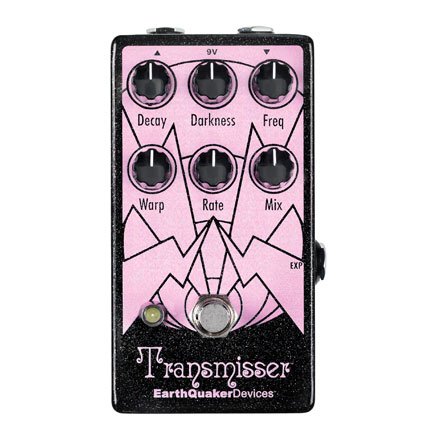
Towers Stereo Reverberant Filter vs. Transmisser Resonant Reverberator
Let’s set the table: Towers is not a revived or stereo Transmisser. If that were the case, we probably would have just called it "Transmisser 2: Electric Boogaloo."
Here’s what Towers does that Transmisser does not:
It uses a completely different reverb algorithm than Transmisser
Applies an active form of resonance to the reflections internally, in a way not typically achievable with hardware.
Three distinct filter modes.
Offers true stereo, mono-to-stereo, and mono-to-mono signal flow.
Full expression pedal control over parameters.
Ability to save and store user presets.
It’s readily available! While Towers is in regular production, the Transmisser got sucked into a black hole and burst into a cloud of cosmic dust years ago.
Here’s what Transmisser does that Towers does not:
It uses a completely different reverb algorithm than Towers
Features a “Darkness” knob to control the tone of the reverberated signal.
Features a system slew control called “Warp.”
Includes a Rate knob to control the speed of the system-wide modulation.
Where they are similar:
Both pedals play off the concept of introducing resonance into the reverb tails.
Controls for Mix, Frequency, and Length/Decay of the reverb tails.
The Bottom Line: While Transmisser has a "static" relationship with its resonance, Towers is highly responsive. The three different filter frequencies and expression pedal capability open the door to unique, dynamic soundscapes that Transmisser just wasn't built to produce.
Before we let you go, we should probably mention Astral Destiny. Based on looks alone, one could easily assume they are similar, but aside from sharing the “Stretch” feature, they have very little in common. They’re completely different reverb algorithms. Where Towers injects resonant filtering into its reflections, Astral Destiny introduces upper and lower octave textures into its reverb tails. Comparing Astral Destiny and Towers is kind of a classic apples and oranges comparison. Yeah, they’re both fruit and sure they’re both good for you, but they’re completely different textures and flavors and different enough that not everyone who likes one will like the other and therefore not really suitable for comparison.
So to make a long story short, Towers is a completely new circuit, though it carries the DNA of its ancestors. The otherworldly stuttering reflections of the Afterneath, the ethereal resonant filter of the Transmisser, and the intuitive feature set of the Astral Destiny are all part of the Towers genetic makeup—but none of those traits define it.
We hope this article has helped you level up your understanding of Towers! If you’re looking for an even deeper dive into our reverb lineup, check out our blog: Testing For Echoes: An EarthQuaker Reverb Pedal Shootout.

Corey Jenkins is the Marketing Specialist at EarthQuaker Devices. An Akron, Ohio native, he started chasing tone at age nine after hearing Mick Ronson's guitar work on "Ziggy Stardust" for the first time. He has been active within the local music community for years and has worked professionally as a creative problem solver for the past decade and a half. In his spare time, Corey enjoys spending time with his son, his three cats, and his 1973 Univox miniKORG K1.