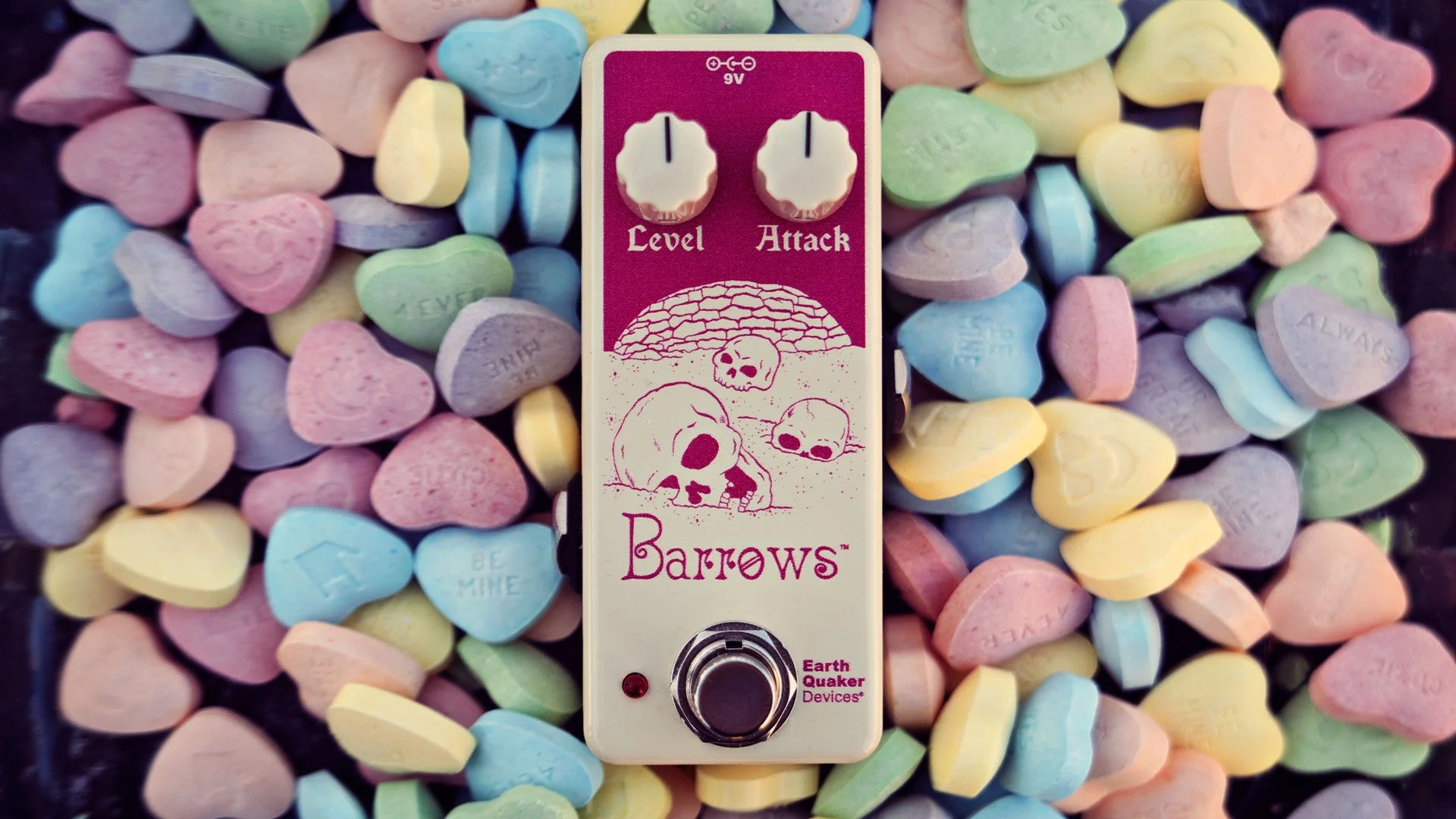
Boy Meets Barrows: A Fuzz Story
Corey Jenkins
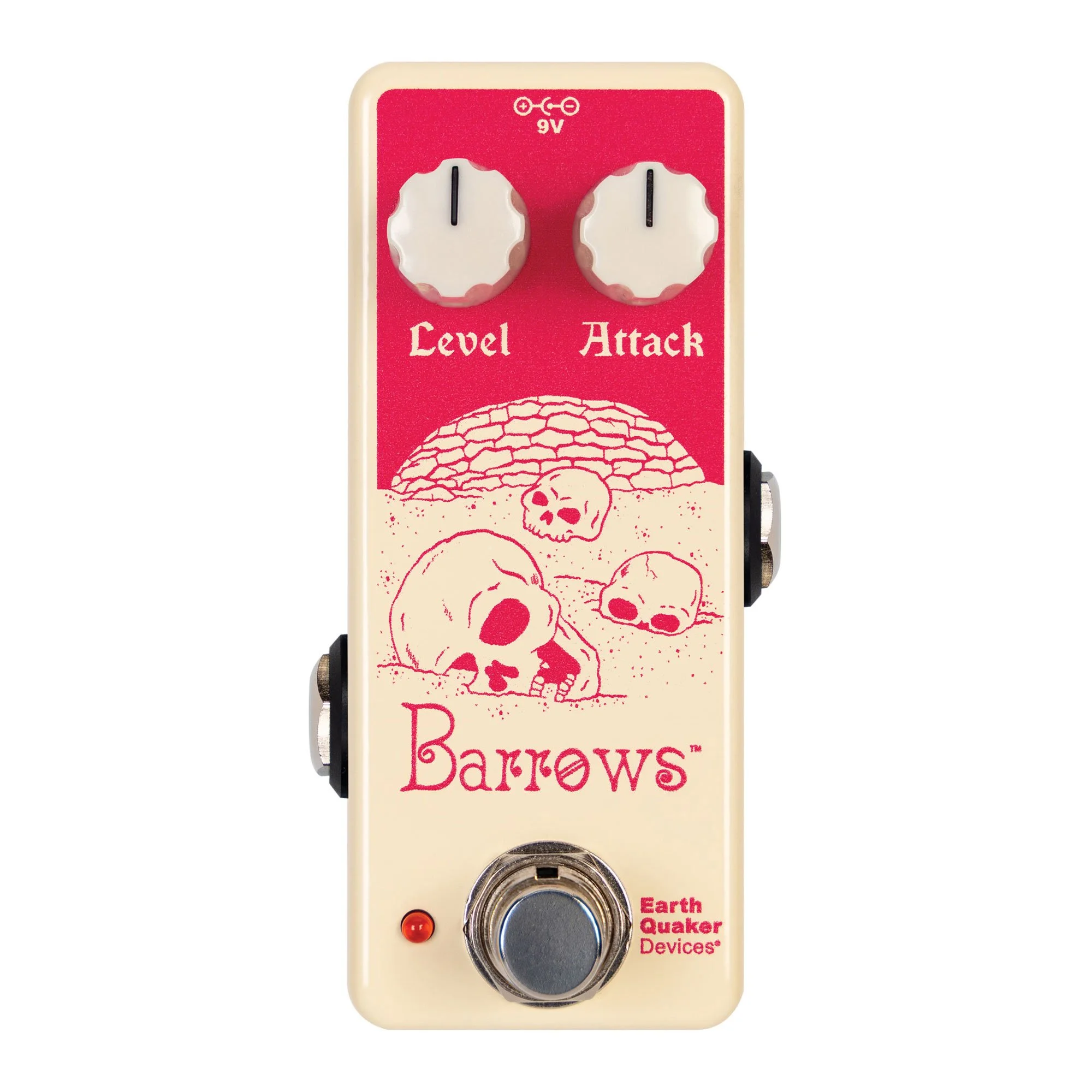
Greetings friends! If you're anything like most of us at EarthQuaker, and I’m going to assume you are since you're reading this, you probably love fuzz. And if you’re reading this and if you love fuzz, then logic would dictate that you’re probably aware of the Barrows Fuzz Attacker that we released back in September 2025.
This cute little guy is our loving homage to the iconic MKII Tone Bender circuit and has been one our most successful new releases thanks to the support and enthusiasm of fuzz freaks like yourself.
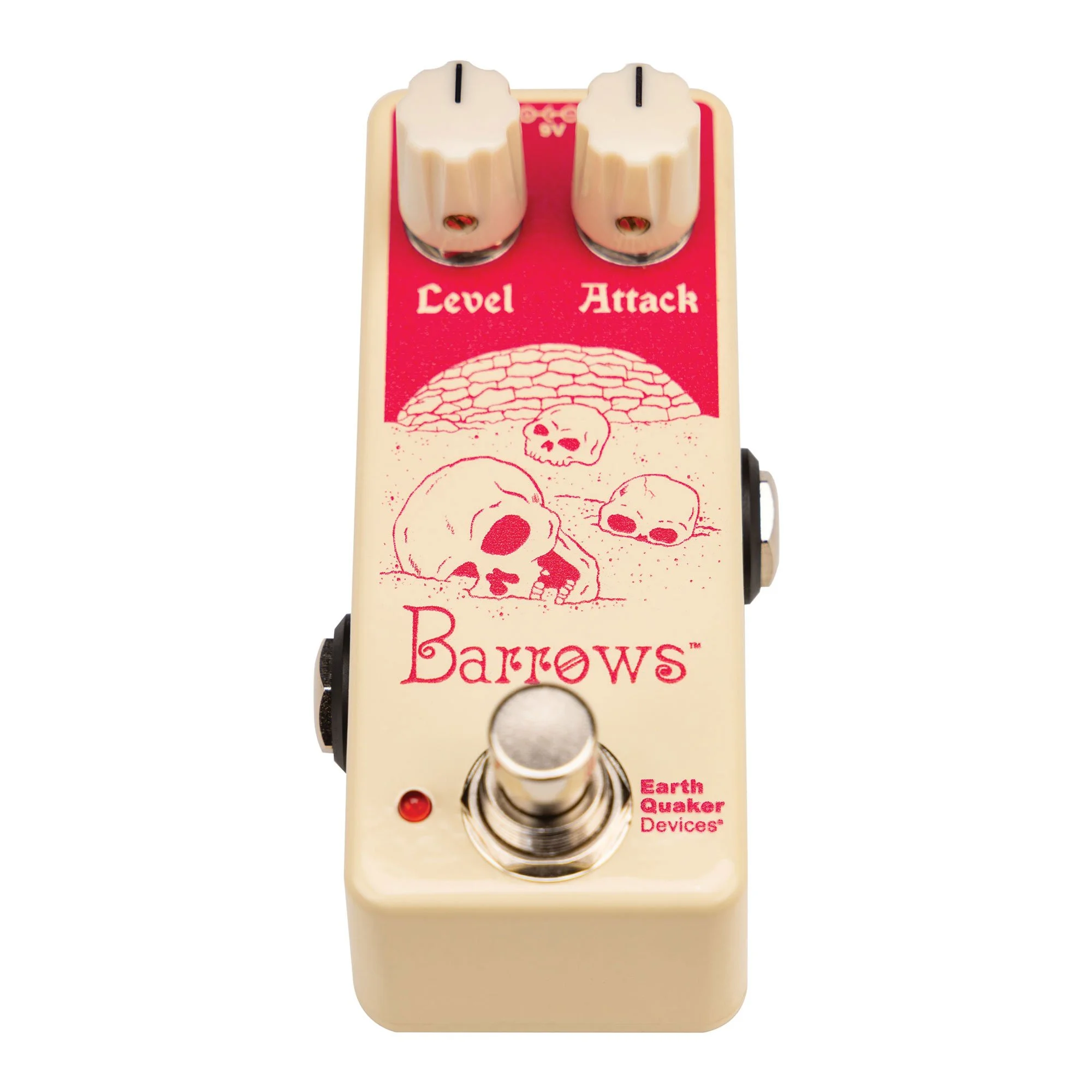
The beating heart of Barrows is its trio of germanium transistors, so before we go any further, I’ve asked Matt Clouston, Product Manager and resident circuit geek at EarthQuaker Devices (think of him as the Doc Brown to my Marty McFly), to explain the difference between two-transistor and three-transistor fuzz circuits in a way that even my feeble mind could understand.
He was nice enough to scribble out the following insights on the back of a Denny’s placemat for me:
Two-Transistor Fuzz Circuits
Most famously found in the Dallas Arbiter Fuzz Face circa 1965. (Dark Side of The Moon-era Pink Floyd, Jimi Hendrix, The Beatles)
The type of fuzz that simply cleans up when you turn down the volume on your guitar without breaking out a pedalboard tapdancing routine. Eric Johnson and Jimi Hendrix are some of the best sources for live examples of this.
Mellow, simple, stable, easy to use
Three-Transistor Fuzz Circuits
More aggressive and saturated fuzz tones than achieved with two-transistor designs.
It’s more Stones than it is Beatles. Think of the raspy fuzz on “(I Can’t Get No) Satisfaction” or Jimmy Page’s fuzz tones on Zeppelin I.
Most famously associated with the Sola Sound Tone Bender Circuit that served as inspiration for Barrows
Three-transistor fuzz circuits make it possible for a tone control to exist in the design due to the circuit’s ability to accommodate a recovery gain stage after the tone control.
Ok, so far we know that Barrows is a three-transistor fuzz and, thanks to Doc Clouston, we’re clear on the differences between two- and three-transistor fuzz circuits. At this point, I’m going to assume you have a good idea of what Barrows sounds like, either because you own one or you’re familiar with the three-transistor fuzz sound. If not, I strongly recommend you check out the product demo video sandwiched between this paragraph and the next.
For me, the sound in a compact footprint is only part of why Barrows is an instant board-essential for any fuzz fan. Do I love that the pedal delivers on its advertised promises of producing everything from light, singing distortion to crushing fuzz tones with nearly infinite harmonic-rich sustain. Yes, I do. Do I love that I can put it in a chain with my Les Paul, wah, and Marshall JMP to play every guitar riff Mick Ronson ever played with Bowie and shake all the pictures off my wall? OMG, a thousand times yes.
“The Barrows is my favorite take on the Tone Bender MkII circuit. I love the sustain, the way it cleans up with the guitar’s volume knob, and how flexible the gain is.”
But what I really love is how freakin’ usable of a fuzz this is. I’ve read enough comments, reviews, and threads to understand I am not alone when I say that I love fuzz, but always had trouble making one sound good on a pedal chain or on a board with other pedals. As a big time user of modulation and time-based effects, this was always a big problem for me whether I was recording or playing live.
It just wasn’t practical for me to have a fuzz and the story was always the same. Boy meets fuzz, boy falls in love with fuzz, fuzz turns out not to be who boy thought and breaks boy’s heart. The cycle always ended with me selling my fuzz and living a fuzz-less life until I was ready to get my heart broken again.
But then I met Barrows. Barrows wasn’t like all the other fuzzes. There was something different about Barrows. Barrows was able to break the cycle because Barrows has a phase-corrected and buffered output.
What does that mean? Well, vintage-style fuzz circuits typically sound weak or degraded in a pedal chain primarily because of impedance mismatches that occur when buffered pedals are placed before them. This is because buffered pedals have an output signal that is a lower impedance than the input impedance of a non-buffered or true bypass pedal, like a classic Tone Bender circuit.
“I love Barrows because it responds so nimbly to the dynamics of my playing, creating endless textural possibilities. It’s amazing how a pedal with just two controls has so much sonic potential.”
The aural result of an impedance mismatch is a loss of high-end frequencies, reduced dynamics, and an anemic, noisy, compressed and overall undesirable sound. Barrows, however, is designed with a buffered output. So it plays nicely with all the other pedals in your chain. And because it’s phase-corrected, the signal leaving the Barrows is in phase with the signal entering it. This prevents sound cancellation when stacked with other pedals in a series setup on a pedal board or in a parallel setup like the kind you can run with our One to Four Splitter and Four to One Mixer.
“It does what I want it to do — the fuzz tone sounds great, stacks well with other effects, responds well to pick attack and guitar volume roll–off, and sustains in a very cool way.”
The original Tone Bender MKII was released in 1966. It’s sixty years later and now we have Barrows Fuzz Attacker at our disposal—a pedal that captures all of the original’s strengths and unique sonic fingerprints in a compact, convenient form factor with modern functionality. You should get one, it will make your life so much easier and I can sincerely say my signal chain is so much happier and healthier thanks to Barrows.

Corey Jenkins is the Marketing Specialist at EarthQuaker Devices. An Akron, Ohio native, he started chasing tone at age nine after hearing Mick Ronson's guitar work on "Ziggy Stardust" for the first time. He has been active within the local music community for years and has worked professionally as a creative problem solver for the past decade and a half. In his spare time, Corey enjoys spending time with his son, his three cats, and his 1973 Univox miniKORG K1.